Sunday, February 24, 2019

Mughal Gardens

Erica jumps for joy in front of Rashtrapati Bhavan
Rashtrapati Bhavan is the Presidential Residence of India.  According to Wikipedia, it is the largest residence of any head of state in the world.  It was originally built as the home of the British Viceroy when Delhi became the capital of India in the early 1900s.  The 330-acre estate includes the 15-acre Mughal Gardens, which are open free to the public in February/March every year.

Erica at the Musical Garden
One of the first stops on the Mughal Garden tour was the Musical Garden.  I absolutely love musical fountains, so I was ecstatic!  The others in my group commented that it's the only fountain they've ever seen that danced to Bollywood music.  Unfortunately, the music stopped just as I was about to record a video.

Rashtrapati Bhavan from the Mughal Gardens
From there, we moved on to the Main Garden, which is designed in the Mughal style with water canals symmetrically dividing the garden sections.  From here, we also took lots of great photos of the Rashtrapati Bhavan building.
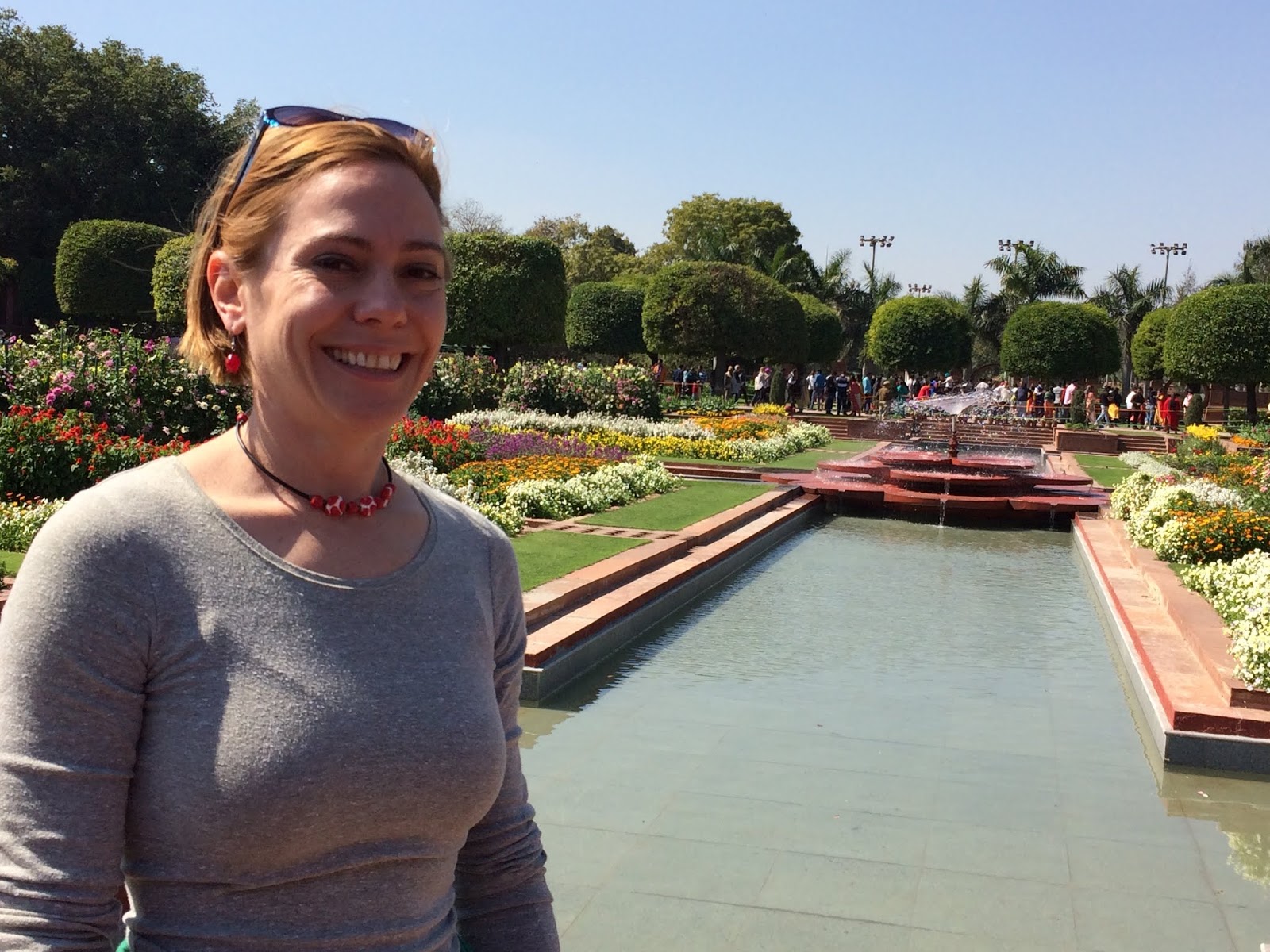
Erica by a Mughal canal in the Main Garden
The weather was absolutely beautiful for our visit.  We seemed to have finally emerged from the Delhi winter.  Yes, we actually have winter here, although many of you will scoff at winter lows in the 40s. More importantly, the main winter pollution season has also passed and the air quality was good, the skies were blue, and the sun was warm.

Circular Garden
The final stop on the tour was the Circular Garden.  This was a section where you could actually get close to the flowers without being blocked by ropes or long expanses of grass.  Everything was in full bloom so I felt immersed in color, with flowers on both sides of the walkway.  Thank you to India's President for allowing us into your garden each spring!

Saturday, February 9, 2019

Cirque du Soleil

Dorian, Erica, Maribel, and Mary practice their acrobatic moves
When I heard that Cirque du Soleil was coming to New Delhi, it was an event I did not want to miss! I've seen Cirque du Soleil before and knew they put on a fabulous performance.  This show, Bazzar, was no exception. 

Bouncy Tightrope
The picture above was what I'm calling the bouncy tightrope.  The rope was strung perhaps 3 or 4 feet off the ground.  Much of the act involved the performer bouncing high off the rope, flipping in the air, and then landing back on the rope.  In this picture, though, he's not bouncing.  He's wrapped his ankles around the rope and is balancing while hanging off the side...obviously with no hands!

One of the best things about seeing the show in New Delhi was that the tickets were cheaper than in America.  We had 3rd row seats for under $100.  It was amazing to be so close to see the performers' facial expressions and to take decent pictures.

Pole Man
I had a hard time thinking of a good name for the performer pictured above.  There was a wooden pole in the middle of the stage and he climbed up it and balanced himself in different positions.  In this picture, he's made it to the top, balancing on one hand.  I love how I snapped the picture just as the backup dancer was posed as if he was looking up at the acrobat in wonder.

Another fabulous aspect of the show was the music.  There was one man who seemed to play every imaginable instrument, from piano to horn to drums.  And there was a woman with the most amazing, powerful, thrilling singing voice.  I was mesmerized every time she appeared on stage.

Seesaw Jumpers
The seesaw jumpers bounced each other high in the air where they did flips and twists before landing back on the seesaw to return the favor to their partner.  Sometimes they were so high, they went above my camera frame.

Now to explain the first photo above.  There was no photoshopping involved!  The lobby of the arena had a photo booth with a fun spherical jungle gym.  So we climbed in - and in my case on - for an awesome group pic showing off our Cirque moves!

Cirque du Soleil Ensemble Dance

Monday, January 14, 2019

Bagan Temples of Myanmar

With my friend Jane living in Myanmar working for the United Nations, I didn't want to miss the chance of being so close but not visiting.  Jane took me to the Bagan Archaeological Zone, a region in central Myanmar studded with 3000 temples built mostly between the 11th and 13th centuries.  

Erica and Jane at Tharabar Gate

Many of the temples were Buddhist and received the faithful bringing offerings and performing worship.  I participated by applying a piece of gold leaf to a Buddha statue.  This act of merit-making supposedly improved my changes of reaching a better future life.

Erica earning merit

The temples also provided rich fodder for fun photos.  Jane assured me that doing silly poses in front of the Buddha statues would not reduce the merit I had just earned with the gold leaf.  Actually, she didn't say that, but she promised it wouldn't be seen as offensive, so I forged ahead!

Erica losing merit??

The most-touristed temples were large and grand, with carvings, morals, and Buddhas galore.  These temples often had impressive golden spires with maze-like inner passages winding past endless Buddha images.

Ananda Temple

As part of our Bagan experience, we rented e-bikes - electric-battery-powered motorbikes.  Although I had driven a moto around a parking lot once while living in Cambodia, this was my first time really driving a motorbike, on real streets with other real vehicles.  Granted, these e-bikes topped out at 30 mph, but even after 6 hours, I still never executed smooth turns or conquered my fear of wiping out disastrously.

First time driving a moto!

Despite my uneasiness about the e-bike, it was the highlight of the trip.  Because the real beauty of Bagan was in its atmosphere:  cruising down quiet tree-lined paths; admiring the surrounding landscape sprinkled with small, unnamed temples; suddenly seeing one of the larger temples pop into view; soaking in the peaceful spirit of the area.

Erica enjoying the peaceful beauty of Bagan

Sunday, December 30, 2018

Capital City Minstrels

Since grade school, I have sung in choirs:  school choir, church choir, community choir.  In fact, I have sung in every city I've lived in, even overseas!  Some groups have been small, all-women choirs. Others have been large ensembles of men and women accompanied by a full orchestra.  Many people only associate choirs with church.  While my choirs have always sung some religious music - how can you ignore all the classical greats like Handel and Mozart and even the modern composers like Lauridsen and Bernstein who composed beautiful music based on the Latin mass? - I've also sung plenty of secular music like Broadway tunes, rock ballads, folk songs, pop hits, and more.

Erica singing with Capital City Minstrels

Here in Delhi, I joined the Capital City Minstrels in February 2018.  CCM, as it's known, was formed in 1994 with only 10 singers.  It has now grown to over 40 members and traveled periodically to Europe for performances.  Currently, the group is made up primarily of Indian singers, with a smattering of expats from America, England, Germany, and elsewhere.

Capital City Minstrels in concert

This December, we performed a holiday concert on the theme of peace, with songs about the beauty of winter and the hope of the Christmas season.  One song about a moonlit winter's night inspired our outfits of silver and blue.  Yes, that's me in a sari!  I have to give a shoutout to my fellow choir members who helped drape the sari on me beautifully.  I was hopeless at it myself.  At home, I simply wrapped the sari around myself like a mummy so I could get out the door fully clothed.  Then once arriving at the concert venue, I begged others to fix me up appropriately.

Erica with her fan club!

I was lucky to have several of my embassy friends come see me in concert.  I was really touched by their support and praise.  Some of them had never been to a choir concert before!  Below is a short clip of my favorite song from the concert:  "Sing Alleluia" by Sally K. Albrecht.  May it bring you a moment of joy and peace this holiday season.  Merry Christmas and Happy New Year to all!


Saturday, December 22, 2018

Pushkar Camel Festival

I had heard about the annual Pushkar Camel Fair before arriving to India and had been looking forward to attending ever since.  My chance came when the embassy organized a group trip.  Upon arriving at the fairgrounds, we were immediately met by a swirl of sounds, colors, smells, and dust. We proceeded to the stadium to see if we could catch any of the popular contests such as camel dancing or longest mustache.  While there were lots of camels, horses, and people milling about, no organized activity was going on, so we left to see other parts of the fair.

Erica at Pushkar Camel Fair Stadium

The pathways of the fair were lined with vendors.  Some were selling the usual foods and souvenirs you'd expect.  Others were selling horses!  We inquired into the price of a horse named "Prince" and were quoted $300,000.  I'm betting that was the foreigner price!  There were also lots of stalls selling horse and camel accessories, like saddles, harnesses, and tassels.  While I declined decorations for my nonexistent pack animal, I did buy a small paper mache camel to use as a Christmas ornament. As we browsed the offerings, we had to be mindful of camels moving up and down the paths.  Camels definitely had the right of way at this festival.

A colorfully decorated camel

The highlight of the trip came the next morning.  We woke in the dark for a sunrise camel ride.  As we climbed onto the camels in pairs, we were also treated to the sight of hot air balloons being blown up for sunrise rides.  It was quite stunning for the darkness to suddenly be brightened by a literal blaze of color from the flames inside the balloons; they looked like light bulbs.

Karime and Erica ready to ride!

Once everyone was in the saddle, we proceeded on a tour through the slowly awakening fairgrounds. The venders and traders at this fair did not stay in offsite hotels; they pitched tents right on the fairgrounds.  As dawn broke, we watched as they came out of their tents to drink tea, eat breakfast, brush teeth, and go to the bathroom.  It's the reality in India that going to the bathroom does not always require an actual bathroom or anything besides the ground at your feet.

Camels dine at communal breakfast platter of grass and grains

We ended the ride in what felt like a camel parking lot.  Camels were all around - sitting, standing, eating, some gathered in groups.  Perhaps they were tailgating for the start of the festival day.  But it was a great opportunity for us to wander around and get our fill of camel photos.  You'll notice some of the camels have one front leg bent up and tied.  This is essentially a hobbling device to prevent the camels from running off.  Simple, yet effective.

Erica with the camels

While I never did get to see any quirky contests, I enjoyed the camel fair and another weekend trip to the state of Rajasthan.

Saturday, September 29, 2018

Weekend in Pondicherry

We all know that India was a former British colony, but I never knew there were pockets of the country under French control as late as the 1950s.  One of these is the city of Pondicherry, on the southeastern coast of India.  This seaside city, with its touches of French cuisine, culture, and architecture, is a pleasant getaway from the bustle of Delhi.

I took a walking tour offered by Storytrails.  The tour guide told us fabulous stories about the battles back and forth between England and France for control of the city, the quirks of the various city rulers, and the intrigues as the city developed.  Even though the tour was in the late afternoon, the temperatures were hovering around 90 degrees, so I was grateful for stops in the shade and even more grateful once the sun started to set!

Raj Nivas governor's residence

The tour ended with a farewell drink.  South India is known for its coffee, but since I'm not a coffee drinker, I asked the guide if there were any other options.  She suggested masala milk.  Never having heard of it, I responded:  "Yes, I want to try that!"  Turns out masala milk is milk boiled with ground nuts, saffron, cardamom, and sugar.  It has a bright yellow color, almost like an egg or lemon custard, and a lumpy consistency.  I immediately loved its sweet, creamy wonderfulness!

Erica discovering an Indian treat: masala milk

From Pondicherry, I took a side trip to Auroville, a community that eschews material items, champions hard work, and embraces self-discovery along a path seeking peace, harmony, and human unity.  I will limit myself to that factual description of Auroville's raison d'ĂȘtre and refrain from any further terms that may have positive or negative connotations.

Erica with depiction of Auroville's values

The centerpiece of Auroville is the Matrimandir, which is really hard not to compare visually to Epcot Center or a golden golf ball.  Matrimandir literally means Temple of the Mother and is considered by Aurovilians to be the soul of their city.  This is their place of concentration, introspection, and consciousness.  Visitors may enter only with advance reservations, so I viewed it solely from the outside.

Erica at the Matrimandir

In addition to the above highlights, I ate raw oysters (in India!) and drank a roadside coconut.  It was a weekend full of new adventures!

Sunday, August 12, 2018

Old Delhi and Jama Masjid

Modern Delhi is actually the conglomeration of successive cities built by different ruling dynasties over the centuries.  Each ruler wanted to make his mark by building a new capital city, all within the area now known as Delhi.  The neighborhood now called Old Delhi is the former city of Shahjahanabad, built by Shah Jahan (of Taj Mahal fame) in the 1600s.

While others will surely dispute me, I would say that Old Delhi is the historical center of Delhi.  It is a must-do on any tourist circuit of the city, housing important historical, religious, and cultural sights as well as market areas where you can buy everything from electronics to clothing to spices.  And for Westerners, Old Delhi gives you a taste of "real" urban India, with its crowds, colors, smells, sounds, and overall hustle and bustle.

I recently ventured into Old Delhi to visit Jama Masjid, which translates to Friday Mosque.  It is India's largest mosque (some say) and was also built by Shah Jahan.  It has a massive courtyard that can accommodate 25,000 people.  The prayer hall features an exterior hallway designated for worshippers, but curiously, it did not appear to have any entrances, for worshippers or tourists.

Erica in the courtyard of Jama Masjid

The highlight of a visit to Jama Masjid is climbing to the top of the minaret.  The stairway of the minaret is a tight spiral staircase that barely accommodates its two-way traffic.  I also noticed none of the ubiquitous signs in the US warning of a 120-step climb in claustrophobic, dark conditions.  But I reach the top without incident and was treated to a new view of Delhi.  I was struck by the view of tightly-clustered buildings, of roughly similar height, with no significant features to break up the expanse - an urban plain stretching out towards the horizon.

Erica on the minaret's narrow spiral staircase

Delhi - from above

As you may be able to tell from the above picture, a final adventure awaited me.  Just as I exited Jama Masjid, the dark grey skies opened up into a downpour.  I ran towards an auto rickshaw (tuk tuk) but the wily driver quoted an outrageous price, citing the pouring rain.  Refusing to be taken for that kind of ride, I plodded along several blocks to the metro stop, arriving completely soaked to the bone, but triumphant in the experience of my Old Delhi outing.